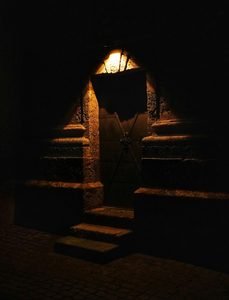
It’s time for another round of Promptober!
Let’s jump back in! We started with Edgar Allan Poe’s The Tell-Tale Heart for part one of Promptober . It gave us plenty to explore – from fear and obsession to madness, guilt, and perception – and showed us how ordinary things can become unsettling when seen through the right lens. It was a wonderfully creepy introduction to the month. For our second round of Promptober, we’re trading Poe’s psychological horror for something a little more supernatural. English writer W. W. Jacobs was a prolific writer whose work included humor, short stories, and tales inspired by his experience of working in the Post Office and his interest in maritime life. Although he wrote in a variety of styles, he is best remembered today for one particular story, which we will be reading today – The Monkey’s Paw.
The Monkey’s Paw gives us a different kind of horror than Poe’s story. Instead of taking us inside the mind of an increasingly frantic narrator, Jacobs places an ordinary family in an extraordinary situation and asks, “What if you could change your fate?” The story explores wishes, fate, temptation, consequence, grief, and the danger of trying to interfere with things we cannot control. What makes the story especially effective, however, is the way Jacobs builds suspense. He establishes an uneasy atmosphere right from the beginning and creates a sense of foreboding that leaves readers anticipating something terrible. Jacobs also uses irony to turn the characters’ wishes against them.
Read The Monkey’s Paw and think about how Jacobs uses setting, foreshadowing, irony, suspense, and the unknown to build an unsettling atmosphere.
How does Jacobs make us afraid of something we never actually see?
Why does Jacobs stretch out the timeline between the second wish and the first knock at the door?
How does the author use the physical transformation of the setting to mirror the family’s internal shift from hope to despair?
The story builds toward the famous knocking at the door, but Jacobs leaves much of what is happening outside to our imagination. By withholding the answer, he allows our own minds to fill in the frightening details. The result is suspense that grows from anticipation rather than from seeing the horror itself. This is a brilliant example of negative space in fiction. Jacobs uses absolute silence and a simple, rhythmic knock to build a climax that feels almost claustrophobic. The horror isn’t necessarily what could be on the other side of the door, but the agonizing wait to see whether the door will even open at all.
With this concept still fresh in your mind, let’s see where it takes you. For the next four days of Promptober, write a short story, poem, reflection, collection of thoughts, scene, or anything else the following words inspire:
October 4th – wish
October 5th – fate
October 6th – knock
October 7th – night
Interpret them literally or let them take you somewhere unexpected. And if you decide to share what you write, I’d love to see it! Share your work on Facebook or Instagram and tag @paigeturnerblogs. You can also use #paigeturnerblogs and #themodernfolio so we can find your work and follow along with Promptober.
Feed your mind (and mind what you wish for)!
Paige Turner
Leave a Reply