What is the price of happiness? Some dystopian fiction suggests that the price of happiness is the realization that it is not separate from suffering, whether we are living with the knowledge, becoming desensitized to it, or attempting to remove that awareness altogether. Across many different stories, we are presented with the idea that happiness was never free – only distributed differently. But maybe that recognition doesn’t diminish joy, but simply makes it more intentional. Because while happiness is not necessarily pain itself, it is the familiarity with the idea that somewhere, in some form, pain is part of what holds it up.
It is a fairly common experience to be faced with an opportunity or decision that seems too good to be true. We are oftentimes left asking, “But what’s the catch?” Because isn’t there always a catch? Such are normal thoughts in stories of the dystopian nature. For example, in The Giver, pain and conflict have been eliminated, but at the price of individual thought, emotion, and memory. In Aldous Huxley’s Brave New World, he taps into the pursuit of happiness at the concession of freedom and humanity. It is by these forms and others similar that we are trained to expect that happiness and comfort come with an unseen cost.
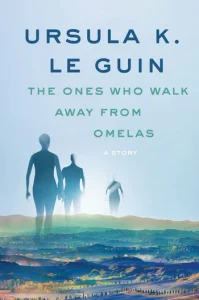
This idea is not just abstract theory. It is explored directly in Ursula K. Le Guin’s The Ones Who Walk Away from Omelas. In this short story, the collective happiness of a completely utopian, seemingly ideal city is sustained by the conscious acceptance of a single child’s suffering.
Read The Ones Who Walk Away From Omelas and think about the following:
Moral dilemma/compromise
Knowledge versus complicity
Escape versus accountability
The instability of utopias
Why do you think the author avoids giving precise details about Omelas’s laws, government, or history?
Can a system built on suffering ever be morally redeemed if it is “effective”?
What information does the story intentionally leave out (such as justification, rebellion, or resolution), and how does that shape its meaning?
Why is the moral dilemma presented in such a simple form (one child vs. many people), and how does that simplicity actually intensify its complexity?
Why do you think most citizens of Omelas choose to stay rather than leave, even after they understand the truth?
What do you think it means to “walk away” in this story – and do you believe it represents moral courage, escape, or something else?
What is the significance of Omelas being described as beautiful, peaceful, and almost timeless, with no clear conflict outside of the child?
Do you think a “perfect society” is possible without some form of sacrifice or inequality? Why or why not?
What does the story suggest about how shared knowledge of injustice can still result in very different personal reactions?
In the story, we do see that some people decide to leave Omelas. Is refusing participation enough to be morally “good,” even if it changes nothing?
Maybe happiness was never meant to be untouched. Maybe it was always something built with awareness at its edges – something we recognize not because it is free of suffering, but because we have learned where to look for it and what not to look at. While dystopian stories don’t normally give us comfort in this realization, they do make these patterns impossible to ignore. Once you notice them, it is hard to return to the idea that pure, idealistic joy ever stands completely alone. There is comfort, however, in that it can make you appreciate it more deeply when you do find it.
I hope this reflection encourages you to step back and see happiness as something deeply interconnected rather than isolated. I challenge you to notice the care, effort, and unseen weight that often exist beneath the surface of joy – and to let that awareness deepen your gratitude for the moments of peace you experience.
To the things we don’t always see, but always carry!
Paige Turner
Leave a Reply