When does something stop feeling familiar and start feeling foreign? It’s tempting and almost too easy to think that the answer lies in physical, measurable distance – the kind that creates different cultures, different practices, and different ways of living. But this shift isn’t necessarily in the thing itself. Sometimes, it’s in the way it’s described and then brought to life in our minds. Because what we recognize has less to do with what is there – and more to do with how it is presented to us.
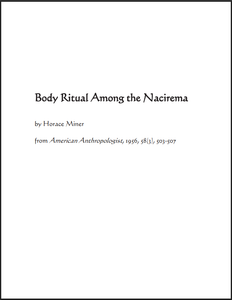
It is a common and natural characteristic that humans are sharp observers outwardly, but become much blurrier when it is time to look within. We are quick to label something as strange or wrong when we don’t recognize ourselves in it. The language we use can make something completely outlandish make perfect sense if you explain it just the right way. It can also make the ordinary feel bizarre when stripped of context. In Horace Miner’s essay Body Ritual Among the Nacirema, he uses language to shape perspectives and readers’ opinions as he documents the exotic routines and culture of a chosen group of people.
Read Body Ritual Among the Nacirema and think about the following:
Perspective and familiarity
Framing and context blindness
Cultural relativism and hidden bias
Language
In what ways does language quietly guide what I believe I’m seeing?
What assumptions did I bring into the reading without realizing it?
How quickly did I start forming judgments, and what triggered them?
How does the lack of personal voice or emotion shape my reading experience?
What effect does the formal, academic language have on my trust in the narrator?
At what point did I begin to recognize the Nacirema as familiar rather than foreign?
What techniques does it use to make me accept its framing before I question it?
What does it mean to truly observe something without immediately labeling it?
How does the writing style itself become part of the message? Would the essay still work if it were written in a neutral or familiar tone?
We believe that we are experts at recognizing what is broken as long as it doesn’t seem like it belongs to us. But in reading Body Ritual Among the Nacirema, it becomes clear that nothing about what we see is fixed in how we understand it. Language begins to do most of the work for us, guiding what feels familiar and what feels foreign. In this essay, different perceptions and perspectives wouldn’t work without the appropriate language to create the illusion of distance. And maybe that is the real realization: that distance is not always something we travel into, but something that can be created for us, simply through the way a story is told.
I hope this essay reminds you that what feels distant is not always far away. It is merely shaped by the lens through which we’re asked to see it. I challenge you to listen more closely to the language shaping your understanding – and what it might be hiding in plain sight.
To the ways we see, and the ways we are seen!
Paige Turner
Leave a Reply