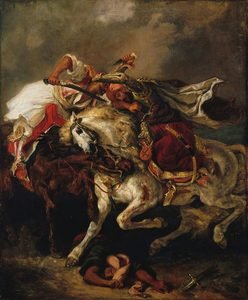
With October now upon us, I feel it would be an injustice to ignore the opportunity to take advantage of a good Halloween theme, for who doesn’t love the spooky season? Monsters have been a part of stories since the invention of writing, and even before then in the form of drawings. Though they have evolved now to the main purpose of invoking terror for entertainment, they were used originally to explain the unexplainable and as physical representations of fears and anxieties. Among the many creatures that have haunted human imagination, none have lingered quite like the vampire. Long before Dracula took shape, Lord Byron offered one of literature’s earliest glimpses of this figure in The Giaour, predating even Polidori’s The Vampyre – a story directly inspired by Byron himself.
The Giaour is a single story told through three perspectives. It centers on a possessive and tragic love triangle between a Christian man (the Giaour), a Muslim concubine, and her husband. When Hassan learns of Leila’s forbidden love with the Giaour, he kills her by drowning her. Fueled by passion and anger, the Giaour takes his revenge by murdering Hassan. Haunted by Leila’s death and the weight of his own vengeance, he withdraws to a monastery, where he lives out his final years in torment and remorse. Written during the height of the Romantic era, the poem reflects the period’s fascination with emotion, the supernatural, and the darker corners of the human soul. Byron weaves all of these elements together, creating a story that feels both intensely personal and mythic in its scope.
It’s the intertwining of human emotion and poetic beauty that draws me to this particular poem again and again. And in no part of the story is this more vividly expressed than in the curse that transforms the Giaour, illustrating the full weight of his actions. After Hassan’s death, a voice – often interpreted as that of a monk, a prophetic curse, or even divine judgment – describes the punishment that awaits him. It declares that before his soul can rest, he will return to earth as a vampire, doomed to prey upon his own kin:
But thou, false Infidel! Shalt writhe
Beneath avenging Monkir’s scythe;
And from its torment ‘scape alone
To wander round lost Eblis’ throne;
And fire unquench’d, unquenchable –
Around – within – thy heart shall dwell,
Nor ear can hear, nor tongue can tell
The tortures of that inward hell! –
But first, on earth as Vampire sent,
Thy corse shall from its tomb be rent;
Then ghastly haunt thy native place,
And suck the blood of all thy race,
There from thy daughter, sister, wife,
At midnight drain the stream of life;
Yet loathe the banquet which perforce,
Must feed thy livid, living corse;
Unlike the later Romanticized vampires of literature, this one isn’t portrayed as seductive or powerful, but instead as a figure of horror and punishment, cursed to destroy everything it once loved. The imagery is brutal and gothic, not just about supernatural revenge. It’s about what guilt does to the soul – how vengeance consumes a person until they become something monstrous, feeding on their own pain; the symbol of moral and emotional damnation. The passage also reflects Romantic obsessions with excess, transgression, and the cost of passion. The Giaour’s intense love for Leila drives him to murder, and in that act, he seals his own spiritual fate. The vampire curse becomes a metaphor for that endless cycle of destruction – to harm what you love, to loathe what you’ve become, and to live forever in that torment.
I’ve always been drawn to tragic stories. I don’t always seek the perfect, happily-ever-after endings; perhaps that comes from knowing that life itself is rarely perfect or easy. There’s something deeply human in the way sorrow and beauty coexist on the page. The Giaour has long been my favorite poem for this reason – it carries both grief and grace in every line. And beyond the story itself, I find such comfort in the language of Byron’s era. There’s a poetic music to it, a kind of beauty that feels lost in translation to modern speech, which is why I often find myself returning to the classics.
And yet, it’s not just the tragedy or the language that captivates me. In the spirit of Halloween, it’s tempting to think of vampires and monsters as purely entertainment – but Byron reminds us that the darkest tales often mirror our own fears and regrets. The vampire in The Giaour is not just a creature of the night, it is a symbol of remorse, obsession, and the unending cycle of human passion and consequence. This Halloween, as we delight in stories of vampires and ghosts, I wonder: which of our fears and regrets might be lurking just beneath the surface, waiting to be confronted?
Stay haunted, in the best way!
Paige Turner
Read The Giaour by Lord Byron
Leave a Reply