There is a particular kind of immersion that comes with getting lost in a good story – the sense that the real world fades for a while and is replaced by something entirely different, vivid, and absorbing. People are drawn to fiction because it allows them to experience ideas, emotions, and perspectives beyond their own lives. Different readers seek different things from it: escape, self-reflection, wonder, or simply just entertainment. There is also comfort in its distance from reality, allowing readers to explore frightening possibilities from a safe place. But there is something especially unsettling about a story that feels exaggerated and unreal when you begin recognizing pieces of it in your own world.
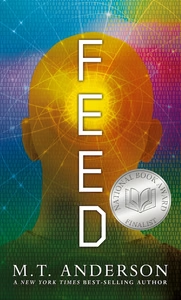
Many dystopian novels create worlds that feel far off from our own – divided into factions, ruled through spectacle, or rebuilt after catastrophic collapse. But unlike many dystopian stories that place their horrors in distant societies, M. T. Anderson creates a world that resembles our own closely enough to feel possible. Published in 2002, just a few years before the first iPhone was released, Feed feels almost like an anticipation, a warning, of a more modern, imminent dystopia. And what makes it so disturbing is not in how futuristic it feels, but rather in how familiar it feels.
Told from the point of view of a teenager named Titus, Feed takes place in a future where most people have a computer brain implant called “the feed” that connects their minds directly to the internet and provides them with constant information, entertainment, and personalized advertising. While vacationing on the moon, Titus and his friends meet Violet, a girl trying to resist the feed’s control. Shortly after meeting, the group experiences a sudden malfunction – a hack that disrupts their connection. As Violet’s relationship with Titus develops, she reveals that the hack has damaged her feed and her health is beginning to fail. Through their story, we witness a society so dependent on the feed that it has forgotten what it means to be truly human.
One of the first things I noticed about the novel was the slang-heavy dialog. At first, I found it an interesting characteristic of the story, but once I realized what the feed actually was, I drew an immediate connection to the obsession with technology being the downfall of humanity. Although some readers have struggled with the simplified language and intellect decay, these details are exactly the point of the story. The characters’ detachment from one another reflects a society that has forgotten how to feel. As Violet’s condition worsens, Titus grows increasingly uncomfortable around her – not heartbroken, but inconvenienced, his emotional depth dulled beyond cruelty into emptiness, almost blaming her for dying. In addition, when analyzing the broken language throughout the book, it becomes clear that words have been completely stripped of emotion and meaning; no one, apart from Violet and her father, speaks with any sincerity or reflection. With information so readily accessible (even more so than in our world today), we see the loss of what once made mankind human.
While Feed explores many powerful themes – from technology and identity to human connection and morality – I believe consumerism safely encompasses them all. Everything in this world revolves around consumption: of information, trends, pleasure, and even each other. Anderson reinforces this through the very structure of the novel, inserting ads between chapters that mirror the relentless marketing Titus experiences in daily life. Walking around, seeing things, hearing things, or even feeling things can trigger an ad in his feed, prompting him to buy a product he hadn’t even thought about. These details hit uncomfortably close to home, reminding me of today’s ad culture – AI-generated products and social media algorithms (like TikTok) that produce endless feeds of personally tailored content to keep us scrolling, buying, and consuming. The consequences of this obsession extend beyond human relationships and into the environment itself. Entire forests are leveled to make room for factories that pump oxygen for people to breathe, prompting Violet’s haunting plea that “trees make air.” On a visit to the engineered meat farms, the grotesque mutations in the genetically altered filet mignon reveal how technology, unchecked by ethics, can distort even the most basic sustenance. Through these glimpses, Anderson shows that consumerism is not just a moral decay but an ecological one as well, eroding the world from the inside out.
The amount of reflection that Feed inspires is remarkable. I first read it when I was in middle school, years before it was common for everyone to own a smartphone. The functional dependency on handheld technology was barely emerging, so the concept of personalized advertising and a constant connection to the internet fascinated me at that time. I didn’t buy my first cell phone until I was 21, so reading the book again now at the age of 30, I’m struck by how much technology has evolved to a point that mirrors what Feed predicts. It is scary to say that I barely noticed these changes as they were happening. A little over a decade ago I was still carrying around school textbooks; today, they seem to be almost completely obsolete. Half the time that my kids are in class, they aren’t reading from books or off of paper; they’re completing assignments on laptops that automatically grade their performance. Today, robots deliver food to tables, shopping can be done entirely without leaving the house, and sometimes work can be attended without even getting dressed for the day. Over the years, I have watched houses and businesses take over the mountains in the city in which I live, and neighborhoods now sit in deserts where I used to hike as a child. Nature is starting to slowly disappear.
Feed is a book that I recommend everyone to read at least once in their life. The strategic use of simplified language and ads throughout the story were a clever characteristic that really helped with the immersion into Titus’ world which so strongly parallels our own. Once I adjusted to the slang, it was easy to stay focused on the story. My attention was held in an ominous manner of speaking. Somewhere along the way, our world began its slow transition into that of Titus’. We walk around, subliminal messaging in the music we listen to, in the television shows we watch, and the store ads that we see, clinging tightly to the feed we carry in our hands – the one with an apple on the back of it.
To the thoughts and actions we can still call our own!
Paige Turner
This book is good for:
Fans of dystopian fiction
People who enjoy thought-provoking themes
Readers who are open to experimental writing styles
People interested in social commentary
Leave a Reply