How do you know if a story is going to be worth reading? Some people decide by reading the last sentence of a book, while others judge it by how well the first paragraph hooks them. Some look up reviews beforehand, and others go in completely blind and hope for the best. Me? I am a power-througher – very stubborn when it comes to putting a book down and calling it quits. I have found this to be a rewarding and eye-opening method because there is always something to appreciate about a novel, and as a literary critic, I always strive to find what it is. So when a novel easily grabs my attention from the beginning and holds it all the way through to the end, it usually finds itself on my list of absolute favorites and easy recommendations.
I started my blog by reviewing books, authors, and novels that aligned with my own personal literary preferences. And while this had been working perfectly well for scheduling and productivity purposes, I still craved variety within my blog. So when I found myself in contact with Seerendip Publishing, an independent publishing company representing authors trying to navigate the throes of marketing their novels without feeling abandoned or overcharged, a lightbulb turned on in my head, and I suddenly realized what my blog was truly meant for. I had always known that I did not want to become another book reviewer discussing the same trending material that every other BookToker and Bookstagrammer was already covering. To stand apart, I had to seek out different material. And so, I found myself reading my first indie novel.
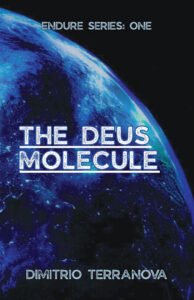
In The Deus Molecule (TDM) by indie author Dimitrio Terranova, Royce Wilko finds himself in a rehabilitation facility called ENDURE after waking up from a years-long coma with fragmented memories, a sinister voice in his head, and an unexplainable hunch that his doctor cannot be trusted. Soon, he becomes acquainted with several other patients in the facility who share the same distrust and suspicions that he does. Together, they develop a plan to uncover the true intentions behind the operations at ENDURE, and in doing so, they not only discover that their suspicions were correct – but terrifyingly so. It is a page-turning psychological thriller that effectively blends elements of science fiction with real-world themes of grief and trauma.
The very first thing I noticed that made this an enjoyable read was the author’s use of descriptive language. It easily placed me inside the story and kept me engaged from the very beginning. Immediately noticeable in the prologue, it was actually the very thing that hooked me. Beyond the descriptive language, we can also look at the story’s narrative structure. The author often used flashbacks, but at no point was the timeline mixed up or confusing. Even with shifts between past and present, the transitions were handled smoothly enough that I was always able to follow what was happening without losing track of the narrative. This is an especially strong characteristic of the story, considering that these shifts moved back and forth between the past and present of several different characters. In these moments, the author was also able to weave small backstories into each character without making the story feel like it drifted away from the main plot. Each detail felt intentional, contributing to the story as a whole and adding depth rather than serving as filler material.
TDM is very rich with psychological and existential themes beneath its science fiction surface. The most recognizable ones – grief and trauma – are explored in a highly creative way. The author is not shy in his depictions of death, with descriptions far removed from “fade to black.” Looking at each of the characters’ brief backstories, it becomes clear that they have all witnessed graphic deaths at close range. Rather than serving as simple background information, this becomes the emotional foundation of the novel. The author uses grief not just as motivation or a driving factor, but as a lens through which the entire story is experienced, choosing to give every major character trauma and proximity to death. This decision to use trauma and grief as storytelling devices rather than mere plot devices or character development tools is a fascinating choice, making these deaths feel intimate rather than cinematic.
First impressions are very important when considering how to hook a reader, but stories do end – so how does an author ensure that theirs are not forgotten? Dimitrio Terranova commented that he has put a lot of time and thought into writing TDM, a whole decade’s worth, in fact. He has stated:
“I’m proud to present a story unlike anything else I’ve read – one that pulls you in with its chilling atmosphere, keeps you questioning every character’s motives, and leaves you wondering what’s real right up to the final page.”
It goes without saying that he has been successful in accomplishing this. At no point during the story was I able to accurately predict what would happen next, which made my reading experience more engaging and immersive; this sense of unpredictability was maintained from beginning to end. To tie together all the qualities that made this book a great read, the story remained extremely accessible. Although the author considers this story to fall under the science fiction genre, I did not feel as if I were reading a typical “alien story.” This helped the book remain grounded and easy to connect with, while still being highly entertaining for fans of the genre.
I am very glad that I decided to explore indie novels; this has quite honestly been my favorite book of 2026. While I am often very happy with the books I choose to open, only a few have left me constantly talking about them long after I have closed them and moved on to my next title. I have been recommending The Deus Molecule to friends and family since I finished it, and I very much look forward to the next four books in this five-part series. You can be certain that I will have my nose between their pages when they are released.
Waiting patiently for what’s next!
Paige Turner
This book is good for:
Fans of science fiction and psychological thrillers
Those who enjoy slow-unfolding mysteries
Anyone drawn to emotionally heavy storytelling
Readers who enjoy layered narratives
Leave a Reply